New: The Armenian genocide.
A new way to commemorate
Link:
http://www.economist.com/blogs/erasmus/2015/03/armenian-genocide
Date: March 10/ 2015
On April 24 one hundred
years ago took place the Red Sunday, the start of what Armenians call the
"genocide" of their people by the Ottoman Empire, the first raid of
what now Turkey assumes as mere collateral damages of war. The initial arrest
of 235 Armenian intellectuals of the community by the authorities of the time,
accused them of "revolutionaries.” It ended with more than 600 arrests and
subsequent Sumerian executions. This was the prelude to mass deportations and
forced into Syria, into the desert, with an explicit veto not to take any of
their possessions. It clearly marked the beginning of a slow death from hunger,
thirst and infections.
The persecution of
Christian Armenians left 300,000 victims at most, says Ankara (Turkey’s Capital);
two million at least say the Armenians. The main international historians have
addressed what is considered as the first systematic ethnic persecution of the
twentieth century and claim that the dead were indeed between 800,000 and a
million and a half[i]. That
simply fits with the concept of "genocide". Just 22 countries
recognize it as such. The latest addition has been the Pope Francis, in a
memorial Mass this anniversary, which first uttered the word damn out of the Pope.
The divergences,
after a century, focus mainly on the voluntarism of this extermination. Was
this a chase calculated to erase Armenians from the face of the earth? Was it a
sought annihilation? Or, conversely, were the dead the unfortunate result of
local throes of World War II?
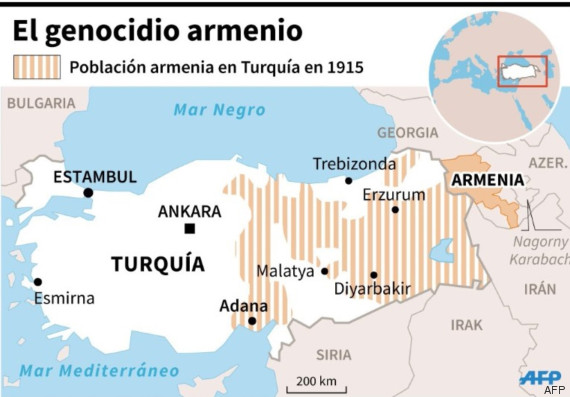
Graphic, taken from the Huffington Post.[ii]
A lack of tangible
evidence is what bases Turkey to deny the largest slaughter remembered in
history. Turkey insists that the deaths occurred as a result of bad planning and
deportations were carried out in a context of open war and, therefore, was
justified as a "military necessity" in the words of the Interior
Ministry, which recognized the first casualty figures in 1916.
The moral muteness
in time of war is itself a moral position: could be born out of fear,
indifference or cynicism. But whatever their psychological, spiritual or intellectual
origins, moral silence in wartime is a form of moral judgment. A poor and
dangerous form. In such circumstances this event is nothing less from a
genocide.
The new brings us
back to the relation and association of right and wrong from two different
perspectives. A vague justification of the actions by the Turkish don’t make
them right. And the remembrance of the Armenians don’t do them justice as they
claim. It poses a cruel situation that occurred and may history forbid it from
happening again.
[i] Ma, A. (2015, April 23). Armenian Genocide Survivor shares her
story. Retrieved April 27, 2015, from
http://dailybruin.com/2015/04/23/armenian-genocide-survivor-shares-her-story-2/
[ii] Rengel, C. (2015, April 24). Cien años de un crimen olvidado.
Retrieved April 27, 2015, from
http://www.huffingtonpost.es/2015/04/17/cien-anos-genocidio-armenio_n_7085636.html
